Birth Chart Basics: A 5-Step Guide to Your First Reading
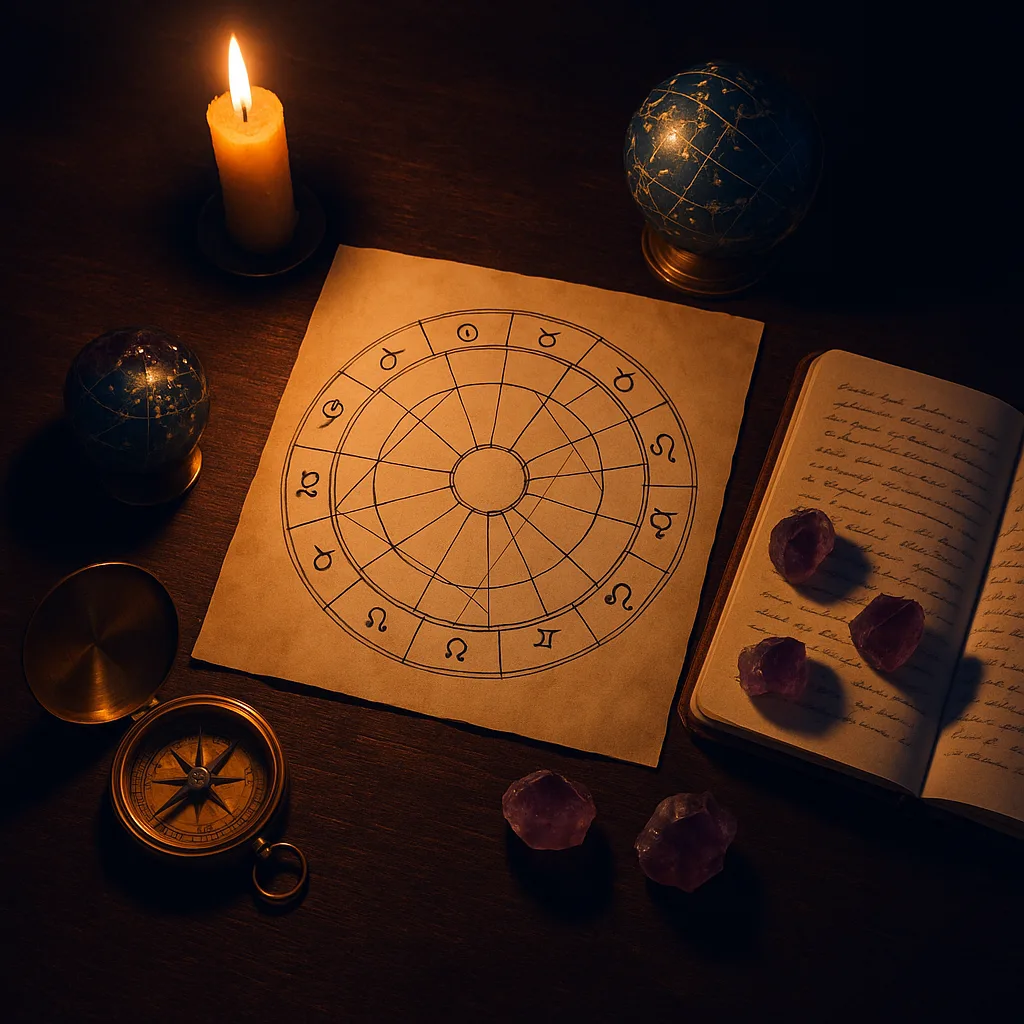
First Things First: What the Sky Needs to Know About You
Every birth chart is built from three simple but precious pieces of information: your date, your exact time, and your place of birth. It doesn't sound like much, but this trio is exactly what allows astrologers to calculate where each planet was positioned in the sky the moment you took your first breath. Without the correct time, you can still find out which signs your Sun, Moon, and planets fall in — but your Ascendant and houses remain out of reach, since they depend on the precise moment and the horizon as seen from that specific spot on Earth.
If you don't have your birth time written down anywhere, it's worth asking your parents or checking your birth certificate before generating your chart on a website or app. It's a small detail that makes all the difference between a complete reading and a half-finished one.
The Five-Step Roadmap for Your First Reading
Looking at a birth chart for the first time often brings a mix of fascination and confusion — symbols, circles, crossing lines, and numbers everywhere you look. To avoid feeling overwhelmed, follow a reading order that moves from the simplest to the most subtle.
- Step 1 — Find your essential trio: locate your Sun, Moon, and Ascendant. These form the backbone of your astrological identity: the Sun speaks to your core essence, the Moon to your emotional world, and the Ascendant to how you present yourself to the world.
- Step 2 — Check the sign and house of each planet: after the main trio, look at which signs Mercury, Venus, and Mars fall in, and which house each planet occupies. The sign shows the style of expression; the house shows where in life that energy tends to show up most strongly.
- Step 3 — Notice the most obvious aspects: look for standout angles between planets, especially conjunctions, oppositions, and squares involving the Sun, Moon, and Ascendant. These point to where you experience creative tension or natural ease between different parts of yourself.
- Step 4 — Find your Ascendant's ruling planet: every rising sign has a ruling planet. Locating where that planet sits in your chart helps you understand the tone it sets for your personal journey.
- Step 5 — Save the more technical layers for later: retrograde planets at birth, lunar nodes, Chiron, and aspects between the slower-moving planets like Uranus, Neptune, and Pluto deserve patience. They carry deep meaning, but they make far more sense once you're already comfortable with the basics.
There's no rush on this journey. A birth chart can be revisited for years, and each reading tends to reveal new layers as your symbolic eye matures.
Recomendado
Astro Reflexo
Descubra o que os astros revelam sobre quem você é. Em menos de um minuto, calculamos seu Sol, Lua e Ascendente com precisão astronômica e uma inteligência artificial escreve um resumo personalizado só para você.