Angular, Succedent & Cadent Houses: The Hidden Rhythm of Your Chart
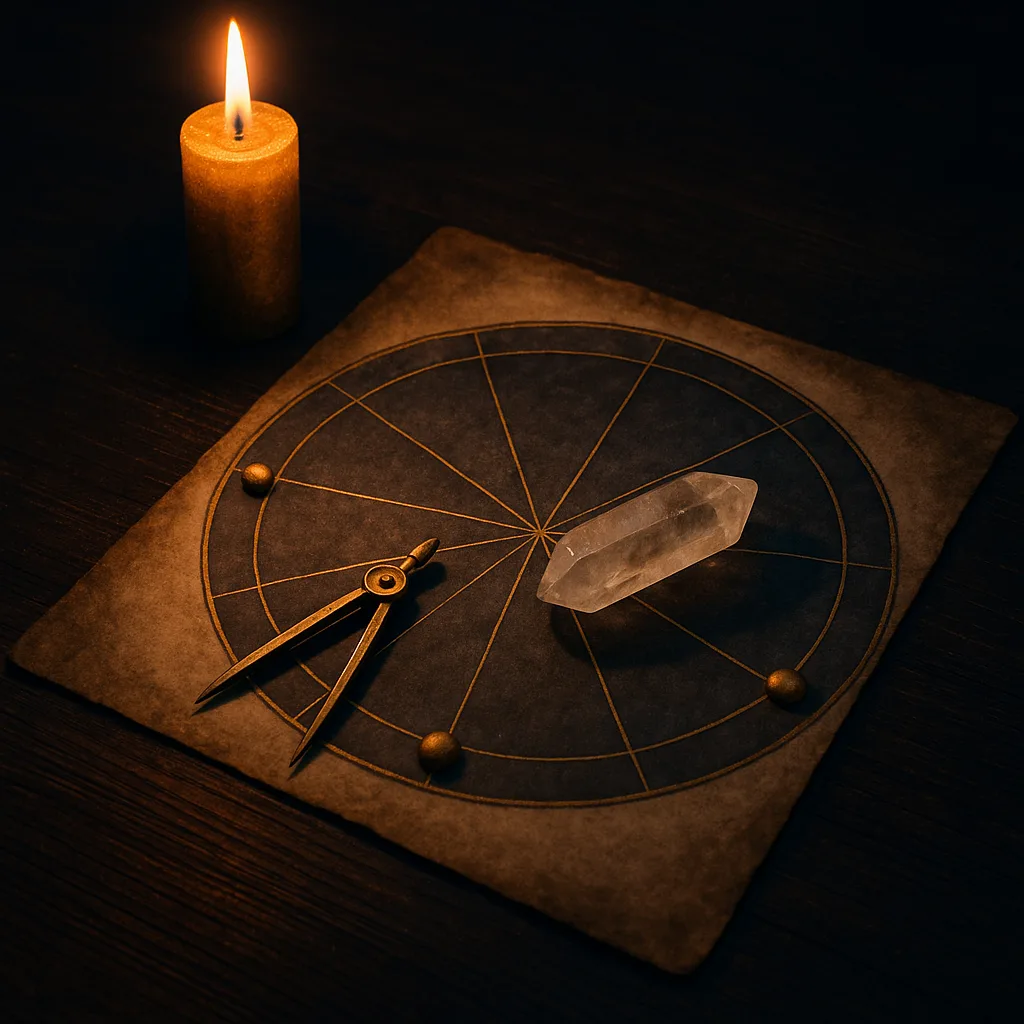
Far more than a list of 12 drawers
Almost everyone who starts studying their own birth chart learns, at some point, that there are 12 houses and that each one governs a slice of life — money, love, work, family. That's true, but it's only the surface. The houses aren't isolated compartments, and they don't all carry the same weight when it comes to telling your story. There's a rhythm behind them, a kind of choreography that repeats itself in every birth chart, for every person, anywhere in the world. Understanding that rhythm completely changes how you read your own chart — and that's what we're here to talk about.
What, how, and where: revisiting the basic logic
Before diving into the rhythm of the houses, it's worth quickly revisiting the logic behind all of Western astrology. Planets represent energies, drives, psychic functions — the what is at play. Signs show the style, the tone, the way that energy expresses itself — the how. And houses point to the stage, the concrete life setting where it all plays out — the where. That's why two people can share the same sun sign and live very different realities: one person's Sun might light up the house of career, while another's illuminates the house of friendships or home.
Houses can only be calculated accurately when the exact birth time and location are known — that's the information that allows an astrologer to build a complete natal chart, rather than just the famous 'sign of the month' that the media popularizes.
The four angles: the compass of any chart
Among the 12 houses, four points stand out for marking the cardinal directions of the sky at the moment of birth. They work like the four corners of a personal compass:
- Ascendant (start of House 1): the sign rising on the eastern horizon at the moment you were born. It speaks to identity, your stance toward life, and the first impression you make.
- Midheaven (start of House 10): the highest point of the chart, tied to vocation, reputation, and the role you play in public life.
- Descendant (start of House 7): directly opposite the Ascendant, it speaks to the other — partnerships, marriage, alliances.
- Imum Coeli (start of House 4): the lowest point of the chart, associated with roots, family, and private life — everything that stays out of the public eye.
These four angles divide the chart into four major quadrants, and they're also the starting point for understanding why some houses carry more weight than others when reading a chart.
The hidden rhythm: angular, succedent, and cadent
Here's the key insight that few introductory articles explain: the 12 houses are organized into three groups of four, and each group plays a distinct role within the cycle of life. It's almost like the four seasons of the year repeating three times over within the chart itself.
Angular houses (1, 4, 7, and 10)
These are the houses that carry the very four angles we just described. They're tied to action, initiative, and turning points. A planet positioned in an angular house tends to stand out in a person's personality and life path — it's as if the stage gets an extra spotlight right there. It's no coincidence that many astrologers pay extra-close attention to these four houses when analyzing any chart.
Succedent houses (2, 5, 8, and 11)
These come right after each angular house and serve to consolidate what was started. If House 1 initiates identity, House 2 asks: now, how do I sustain that identity materially? If House 4 speaks of roots, House 5 asks how you express and enjoy what you've built at home. These are houses of resources, values, and permanence — they provide the ballast so the impulses of the angular houses don't get lost in the wind.
Cadent houses (3, 6, 9, and 12)
These close out each cycle of three, preparing the ground for the next beginning. They're tied to learning, adaptation, and transition — it's time to digest the experience before starting everything over again at the next angular house. Communication, routine, philosophical expansion, and inner life are all part of this more reflective, less visible phase of the cycle.
Noticing this movement — starting, sustaining, transforming, and beginning again, repeated three times throughout the chart — helps explain why astrology feels so organic: it mirrors the very rhythm of nature, like the phases of the moon or the changing of the seasons.

Recomendado
MAPA ASTRAL E NUMEROLÓGICO PERSONALIZADO
Mapa Astral + Numerologia Um mergulho profundo na sua essência. E se tudo o que você procura… já estivesse dentro de você - esperando para ser revelado?

Recomendado
Curso MAPA ASTRAL
CURSO DESTRAVE SUA VIDA COM MAPA ASTRAL EM ATÉ 08 SEMANAS!