Tarot from Scratch: How to Organize Your Study of the Major Arcana Without Getting Lost
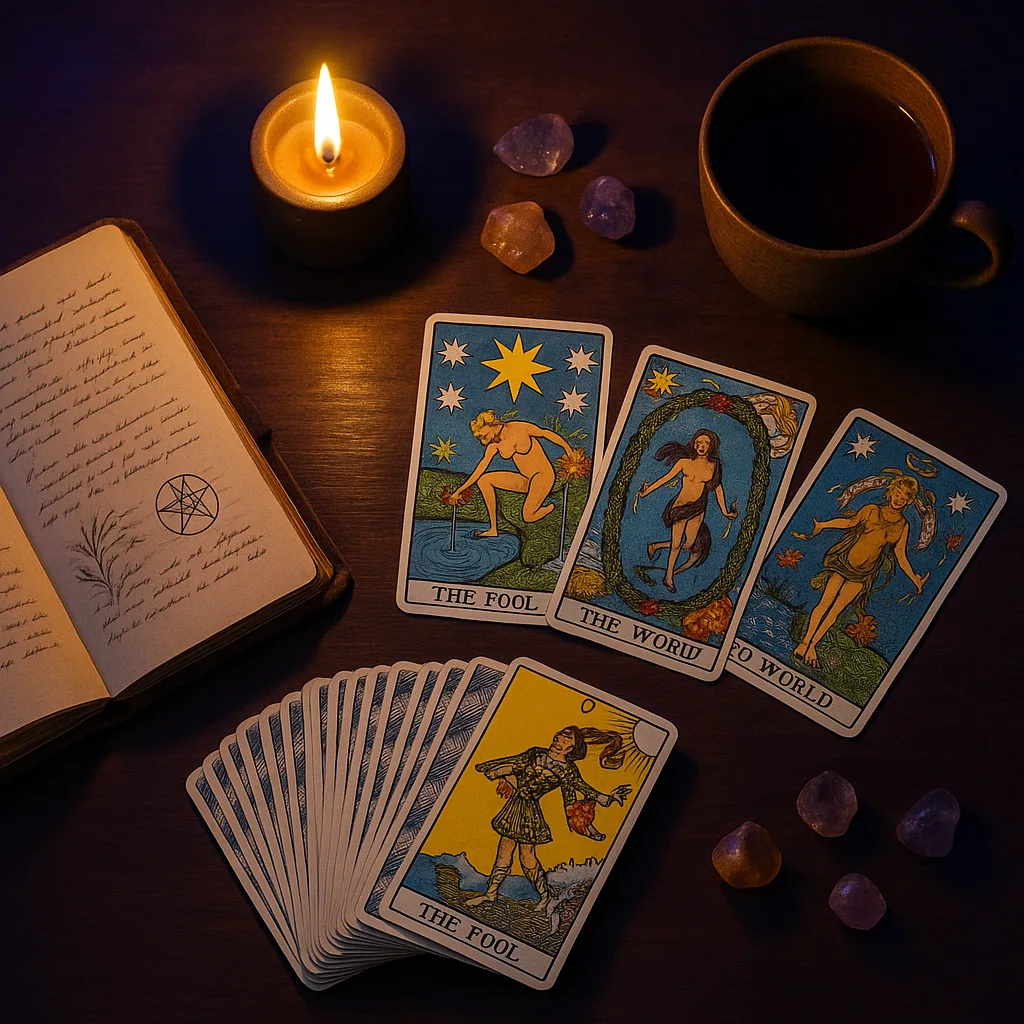
The deck's invitation: why Tarot is both intimidating and enchanting
Anyone who has picked up a Tarot deck for the first time knows the feeling: the images are beautiful, mysterious, almost magnetic — but they're also intimidating. There are 78 cards, symbols everywhere, figures that seem to come from a distant era. The good news is that no one is born knowing how to read Tarot by heart. Every scholar, every experienced tarot reader, started exactly where you are now: looking at a card and wondering, what is this trying to tell me?
This piece isn't about memorizing ready-made meanings. It's about understanding the logic behind the deck and building a study path that makes sense for you, without rushing and without the anxiety of needing to know everything at once.
The architecture of the deck: Major and Minor Arcana
A complete Tarot deck has 78 cards, split into two major groups. The Minor Arcana add up to 56 cards, organized into four suits — Cups, Swords, Pentacles, and Wands — each with fourteen cards, including the court cards: Page, Knight, Queen, and King. These cards speak to everyday life, practical situations, and the small nuances of daily experience.
The Major Arcana, on the other hand, are the 22 best-known cards in Tarot, numbered 0 through XXI, starting with The Fool and ending with The World. The word arcanum itself comes from Latin and means mystery — in French-speaking traditions, like the Tarot de Marseille, it's also treated as a synonym for trump card. While the Minor Arcana deal with the concrete, the Major Arcana carry archetypes: universal themes like love, loss, power, transformation, and rebirth that run through human experience regardless of era or culture.
Worth noting for anyone comparing different decks: the order of the Major Arcana isn't perfectly identical across all traditions. Between the Tarot de Marseille and the Rider-Waite, for instance, the Justice and Strength cards swap positions. Neither version is wrong — they're simply different schools of symbolic organization.
The two inner blocks of the Major Arcana
A helpful way to think about the 22 Major Arcana is to split them into two blocks. The first runs from The Fool (0) to the Wheel of Fortune (X); the second begins with Strength (XI) and ends with The World (XXI). Some scholars describe the first block as the territory of earthly lessons — birth, identity, relationships, practical choices — and the second as the realm of spiritual lessons, more connected to inner transformation and the maturing of consciousness.
It's interesting to see how this reading follows the Fool's symbolic journey: he starts out as pure instinctive energy, with no defined shape, and only gains a sense of identity when he meets the Magician, the card where individual will manifests for the first time. Further along, the Wheel of Fortune marks an important turning point: it closes a cycle of building and opens space for a new phase of unraveling, which deepens until it reaches its resolution in The World.
This division into blocks isn't a fixed, universal rule — different authors organize this reasoning in slightly different ways — but it works very well as a mental map for beginners: it helps you see the Major Arcana not as 22 separate cards, but as a sequence with a sense of movement.

Recomendado
Lewtemi Espelho de tarô acrílico tarô
Lewtemi Espelho de tarô acrílico tarô cartão decoração de parede mística presentes de bruxa para mulheres espaço sagrado cartomante espiritualidade astrologia bruxa magos arte decoração