The Origins of Astrology: A Journey Through the Peoples Who First Read the Sky
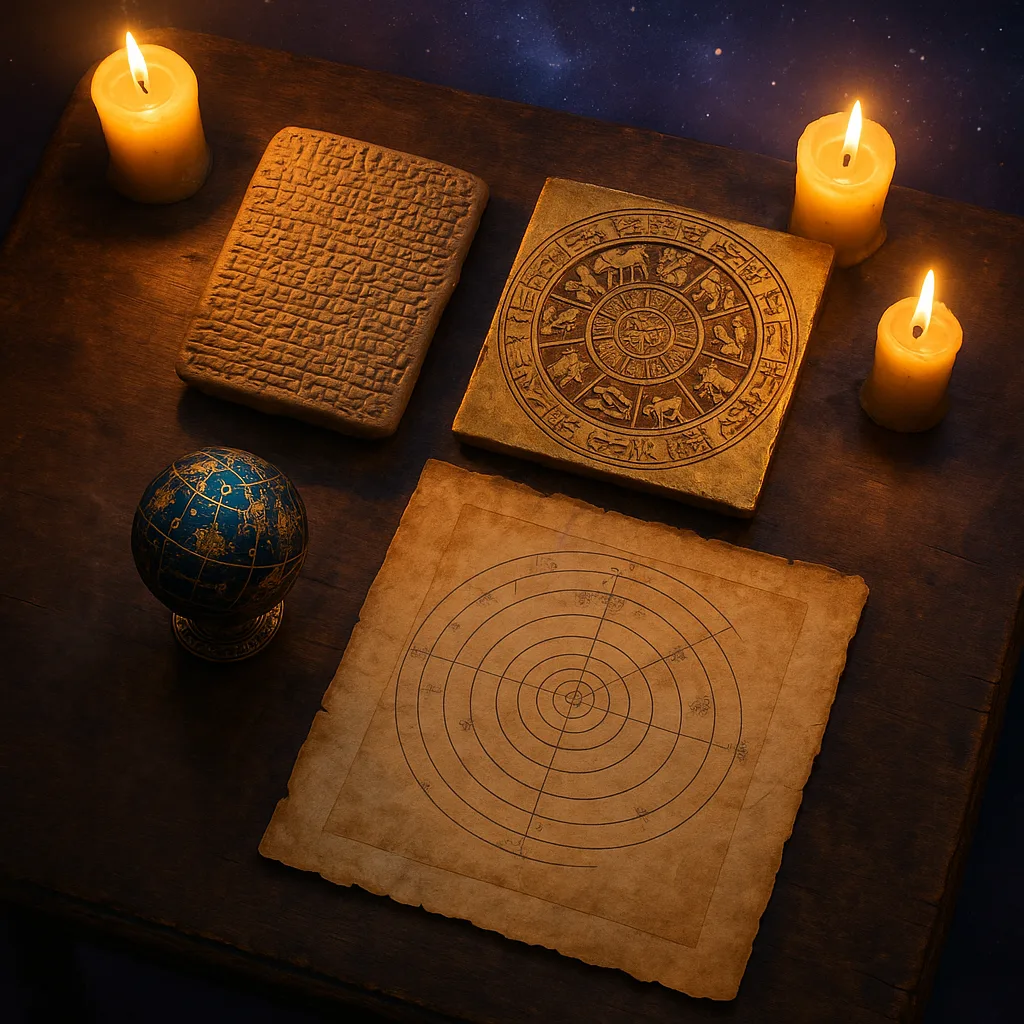
The sky as humanity's first form of writing
Long before printed birth charts, transit apps, or even paper existed, there was the sky — and there were people willing to spend hours gazing at it, trying to understand what those lights meant. Astrology wasn't born from a single people or a single moment; it emerged, almost simultaneously, in different corners of the ancient world, as if humanity shared a common need to find meaning up above. In this article, we'll walk through some of these origins — Mesopotamia, Egypt, Greece, and India — not to memorize dates, but to feel how each culture saw the very same sky in its own unique way, and how these perspectives wove together to form the astrology we practice today.
Mesopotamia: when the gods spoke through the stars
If we go looking for the most well-documented cradle of astrology as we know it, we find it in the fertile region between the Tigris and Euphrates rivers, home over the millennia to the Sumerians, Akkadians, Babylonians, and Chaldeans. For these peoples, the natural world and the divine world were not separate things: the gods dwelled within the cosmos and revealed themselves through it. Watching the sky, then, wasn't scientific curiosity — it was a way of listening to divine will.
It was in Babylon, around the second millennium BCE, that this listening became a method. Specialized priests observed the movements of stars and planets to interpret omens concerning, above all, the fate of the king and the state — not yet the ordinary individual, as we do today when discussing our own birth chart. This knowledge was gathered into an impressive work: the Enuma Anu Enlil, a collection of seventy clay tablets containing roughly seven thousand celestial omens, compiled around the 7th century BCE.
Interestingly, among the many forms of divination practiced at the time — including reading animal entrails — omens read in the sky were considered the most reliable, precisely because they didn't depend on any human interference. It was there, too, that technical concepts still used today first emerged, such as the awareness of the precession of the equinoxes and the base-60 numbering system, which we still use to measure degrees and hours. When Alexander the Great conquered the former Persian territory, this Mesopotamian astrological knowledge crossed borders and made its way firmly into Greek thought.
Egypt: the zodiac carved in stone
Meanwhile, along the banks of the Nile, a parallel civilization was also lifting its eyes to the sky. Ancient Egypt developed, around the same time as Mesopotamia, its own system of astral observation, deeply tied to religion and the organization of time. One of the most beautiful records of this tradition is carved into the ceiling of the Temple of Dendera: a circular zodiac, now removed from its original site and displayed at the Louvre Museum in Paris — a piece that still impresses today for its symbolic precision.
The Egyptian legacy most present in our daily lives, however, is almost invisible: we still use the calendar they helped shape, with the year divided into twelve months and the day into twenty-four hours. Less well known, but equally fascinating, is the system of decans — thirty-six divisions of ten days each, associated with specific stars, which the Greeks would later incorporate and reorganize within the logic of the twelve zodiac signs we know today.
Recomendado
Astro Reflexo
Descubra o que os astros revelam sobre quem você é. Em menos de um minuto, calculamos seu Sol, Lua e Ascendente com precisão astronômica e uma inteligência artificial escreve um resumo personalizado só para você.